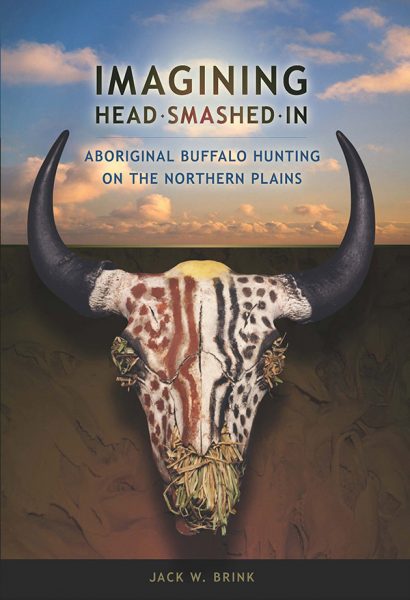
Imagining Head-Smashed-In has been awarded by the Society for American Archaeology as the best archeology book of 2009 in the popular writing category.
At the place known as Head-Smashed-In in southwestern Alberta, Aboriginal people practiced a form of group hunting for nearly 6,000 years before European contact. The large communal bison traps of the Plains were the single greatest food-getting method ever developed in human history. Hunters, working with their knowledge of the land and of buffalo behaviour, drove their quarry over a cliff and into wooden corrals. The rest of the group butchered the kill in the camp below.
Author Jack Brink, who devoted 25 years of his career to “The Jump,” has chronicled the cunning, danger, and triumph in the mass buffalo hunts and the culture they supported. He also recounts the excavation of the site and the development of the Head-Smashed-In Buffalo Jump Interpretive Centre, which has hosted 2 million visitors since it opened in 1987. Brink’s masterful blend of scholarship and public appeal is rare in any discipline, but especially in North American pre-contact archaeology.
Brink attests, “I love the story that lies behind the jump—the events and planning that went into making the whole event work. I continue to learn more about the complex interaction between people, bison and the environment, and I continue to be impressed with how the ancient hunters pulled off these astonishing kills.”
About the Author
Jack W. Brink is Archaeology Curator at the Royal Alberta Museum in Edmonton, Canada. He received his B.A. from the University of Minnesota and his M.A. from the University of Alberta. His interests also include the study of rock art images of the northern Plains, and he enjoys working with Aboriginal communities on heritage issues.
Download the eBook
Copyright: This work is licensed under a Creative Commons License. It may be reproduced for non-commercial purposes, provided that the original author is credited.
Edmonton Journal
Review by Ken Tingley
February 8, 2009
Bringing to life Head-Smashed-In Buffalo Jump
Deeply personal, poetic take on Alberta's First Nations history invites readers into the magic of a sacred site
Head-Smashed-In Buffalo Jump is a World Heritage Site located in southwestern Alberta along the southeastern rim of the Porcupine Hills west of Fort Macleod. This important area, used intermittently for more than 6,000 years, has a profound story to tell about the peopling of North America by its first inhabitants. It exemplifies the subtle relationship between First Nations and the land, and the complex ways in which they found a close interrelationship over the millennia. It is this story that has directed the life and career of Jack Brink for almost three decades.
Brink, who has studied and written about buffalo jumps and native rock art for years, in addition to his deep involvement with many native cultural heritage projects, is curator of archeology at the Royal Alberta Museum. In Imagining Head-Smashed-In: Aboriginal Buffalo Hunting on the Northern Plains, he presents a deeply felt and frequently poetic narrative in which he not only gives us a solid introduction to the issues of Northern Plains archeology, but also brings his experience with this magical site into play. This allows Brink to imagine, and lead our imaginations, into those unknown areas where instinct and intuition remain essential to understanding the prehistoric past.
"To put flesh on the skeletons of these people's lives we have to dream along with them," he writes. "Capturing people and events that disappeared from our world centuries ago requires a judicious helping of imagination ... ."
Brink takes readers on an exploration of the site, telling its story in an irresistible personal voice into which he pours his heart and soul. What comes through is the author's deep respect for his subject. "It can be a daunting prospect," he confides, "knowing that you have to speak for people who are no longer here to speak for themselves. A great weight can descend upon you as you wonder if you have represented these voiceless cultures fairly ... ."
The buffalo jump at Head-Smashed-In was a tremendously successful hunting and processing site, although mysteriously abandoned for some 2,000 years before being reactivated around the beginning of the Christian era. Brink even speculates that it could have produced enough meat in virtual "factories" at the foot of the killing cliffs to serve as a source for trade. It certainly was uniquely efficient for the meat gathering essential to the people living in the region. When the bison were directed over the fatal "jump," perhaps more properly called a "fall," an event occurred that was the indispensable foundation of a whole culture. "In the blink of an eye they obtained more food in a single moment than any other people in human history."
Much of the story at the buffalo jump is not accessible to the uneducated eye. The interpretive centre located at this provincial site, surely one of the most successfully implemented such centres in its sensitivity to the all-important terrain in which it stands, goes far to explain the location. However, the story is a subtle and multifaceted one. Imagining Head-Smashed-In is invaluable preparation for any visit there, synthesizing as it does the wisdom and observation of the native elders, accounts of early explorers and the work of archeologists. Comparing the site with more spectacular archeological icons such as the Great Pyramid, Brink concludes that "simple lines of rocks stretching across the Prairies are every bit as inspirational as rocks piled up in the shape of a pyramid." Readers who visit Head-Smashed-In probably will never view it in the same way after reading this book.
Communal hunting directed and shaped aboriginal society at every level. Brink takes us beyond the bonebeds located at the foot of the cliffs, "merely the detritus of people's knowledge," and relates these final remnants to the broader picture of terrain, bison behaviour, and the seasonal round of a hunter society.
Head-Smashed-In was just the right combination of features -- "not just any cliff." It is probably the oldest known buffalo jump, with the possible exception of one in Texas. Imagining the use of the jump depends upon an understanding of how the aboriginal seasonal round corresponded with bioenergetic principles learned over centuries through hard experience and observation.
Drives were timed to use periods when herds would yield the most fat per volume of biomass taken during a hunting event. "Native groups orchestrated every aspect of a communal bison kill, including choosing the season in which they were held." Head-Smashed-In jump was ideally suited to exploit these patterns of bison physiology and seasonal movement. In the fall and early winter cow-calf groups, then with the highest chemical fat content in its collective tissue, and with the thickest hides for robes, would gather in Olson Creek basin above the kill site, where the true "magic" that led to its success occurred. Natural herd drift was directed toward the "brink of death," a term Brink must have smiled over when he wrote it. The lanes were defined by rock platforms, on which temporary hazing structures made of vegetation were mounted before a hunt, an evolving form of subtle and complex "landscaping" which changed over time, with one ultimate, lethal goal. No other jump appears to have been as successful as Head-Smashed-In.
Imagining Head-Smashed-In is available online through Athabasca University, as well as in paperback and hardcover editions. But its glorious photographs, maps and other graphic elements might lead readers interested in this outstanding Alberta cultural site to buy the hardcover edition.
Alberta Native News
Review by John Copley
Southern Alberta’s Heads-Smashed-In-Buffalo-Jump is a very popular
destination for tourists, no matter where they come from. Located just
15 miles northwest of Fort Macleod, and a stones throw away from the
spot where the great plains shake hands with the Rocky Mountains, the
site, proclaimed to be “one of the world’s oldest, largest and best
preserved buffalo jumps,” will be even more popular now that author Jack
W. Brink has published his new book, Imagining Head-Smashed-In:
Aboriginal Buffalo Hunting on the Northern Plains. His unique style,
developed while penning the articles he’s written on subjects that
include caribou drive lanes on Nunavut’s Southern Victoria Island and
the use and reuse of heating stones and other excavation issues, remains
intact in his first novel, a book that will be of great interest to just
about anyone who likes a nonfiction adventure with a twist of historical
flair.
Jack Brink spent more than 25 years of his career studying, working with
and writing about the buffalo jump located not far from the US/Canada
border and his knowledge about the area, his subject and the intricacies
of the excavation and construction of today’s Interpretive Centre and
Jump site is keen and colourful.
But this book is about much more than a simple guide or information
piece about the popular Alberta attraction; instead it offers a personal
view into all aspects of the Alberta Jump and others like it. The jump,
which provided First Nations communities with large communal traps for
hunting big game is not only a unique tale, it was an important tool
that helped First Nations peoples survive for more than 10,000 years
before the first white settler ever imagined sailing westward. Chock
full of First Nations culture, Imagining Heads-Smashed-In is unlike
most history books you are likely to read; this one offers scholarly
material, and because the public interest is so keen when it comes to
learning and understanding our past, its appeal is overwhelming, and
Brink has made the book even better by writing it in first person
narrative.
“I love the story behind the jump,” he writes. “I continue to learn more
about the complex interaction between people, bison and the environment
and I continue to be impressed with how the ancient hunters pulled off
these astonishing kills.”
The bison of the western plains were once so plentiful that it is said
you could walk across the entire west stepping from the back of one to
the back of another, feet never touching ground; a tale much like the
salmon streams in British Columbia, Washington and Oregon. Though Jack
Brink makes no such claims, the truths he tells and the information he
shares with his readers sometimes seems even more unbelievable than
fiction. It’s difficult for today’s society to even imagine what life
was like for North America’s (Turtle Island) Indigenous peoples over the
centuries before western (modern) civilization encroached on their
individuality, changing forever the vast landscapes and the freedom of
choice, but Brink has done an outstanding job of bringing the past to
the present, allowing readers from every walk of life the opportunity to
experience the comforts and the discomforts of yesterday.
The author shares a wealth of information throughout his 342-page
manuscript, which includes a beautiful array of both black and white and
colour photography and illustrations. In the down-to-earth,
matter-of-fact style that highlights the author’s brilliant storytelling
ability, Brink has utilized each of the book’s ten chapters to capture
the attention, and especially the imagination of his readers. He
provides full, interesting accounts of everything from the proper
designation of buffalo and bison to thorough explanations of the buffalo
jumps, the animals themselves, and an in-depth look at the annual cycle
from calf to yearling to maturity. Brink skillfully captures more than
one moment in time as he leads his readers from the kill to the dinner
table.
Every piece of the bison or buffalo has a use and the Indigenous hunters
of yesterday did not waste a single bone; every piece was utilized to
make food, provide shelter and medicine and help to stay warm on cold
winter days and nights that in this day and age have the hardiest
citizens running for cover.
/Imaging Head-Smashed-In: Aboriginal Buffalo Hunting on the Northern
Plains/ is an outstanding book with a unique tale to tell. The author
uses the past and eyewitness accounts described by early settlers to set
the mood for his story, which includes an abundant source of ancient
legends from the Elders and a host of buffalo jump stories by those who
wrote down what they witnessed on the plains of southern Alberta and
beyond.
This interesting and informative piece of history begins its tale about
6,000 years ago, just about the time the practice of using a buffalo
jump was set into motion. Unlike today, where timber and steel and
plastic combine to construct the largest and most complex of buildings
and monuments, yesterday’s buildings were small and unique and most
often built from the hides of buffalo, and the boughs of the bountiful
conifer trees.
Pick up this book and add it to your collection; it is a must read for
anyone interested in the past, anyone studying history of the plains,
and everyone just looking for some fresh, new and upbeat reading
material. Imagining Head-Smashed-In is a tale about courage, ingenuity
and the struggle for survival. Paperback versions are available for
$35.95; hardcover editions for $85 direct from the publisher, at
http://www.aupress.ca.
Prairie Post
Review by Susan Quinlan
Friday, October 17, 2008
Having spent almost three decades working as an archaeologist, researching the Plains Indians’ way of life, Jack Brink’s interest and expertise have come together in Imagining Head-Smashed-In: Aboriginal Buffalo Hunting on the Northern Plains.
“It was 25 years in the thinking,” says Brink. The story Brink tells takes the reader back 6,000 years before European contact, when Aboriginal people practised a form of group hunting that involved “cunning, danger and triumph”.
With knowledge of the land and buffalo behaviour, Aboriginals drove the buffalo over a cliff while others waited below to butcher the kill, creating the “single greatest food-getting method ever developed in human history.
“The book isn’t really a book about Head-Smashed-In, per se. That forms the nucleus of the story, but it also takes place all over the western plains. How did people make these great kills,” says Brink, answering the question in the style of first-person narrative with historical information and quotes from the region’s early explorers. The book is heavily illustrated with 130 images, photos and paintings by talented western artists.
“I wondered how did they ever pull it off. Standing out in that great expanse, you can actually stand on that cliff and imagine how it was done. It’s mind-boggling. That’s really the story I wanted to tell.”
Curator of Archaeology at the Royal Alberta Museum in Edmonton, Brink has spent most of his professional life studying the Plains Indians and contributing to development of the Head-Smashed-In Interpretive Centre.
Brinks’ interest in Head-Smashed-In started in 1979, when the province set its sights on developing the area, achieving status as a UNESCO world heritage site in 1981.
“That was the leverage we needed to go to the powers that be to get the funding,” says Brink, securing $10 million for site development.
In 1991, the Alberta Government needed someone to lead the project, making the Head-Smashed-In Interpretive Centre a reality, from designing the building to writing text for the displays, and as well, to lead excavation of the site.
“It was a great gift, to be able to stick with that for 25 years, getting to know the story, becoming a scholar on the topic of the Plains people and their hunting the buffalo. It’s a great story …”
Brink spent two years on his own time writing Imagining Head-Smashed-In, then an additional year editing and securing permission for the book’s images. He made a conscious effort to write the book for the general public, telling the story as though relating a personal account to the reader.
Profits from the sale of the book go to the Cross Cancer Institute.
“I’ve already been paid by the government to know what I know, to know what I love, to tell the story of native culture.”
The book is available from the publisher, Athabasca University Press, at the Head-Smashed-In gift store, and online at Amazon and Chapters-Indigo.
National Post
Review by Robert Fulford
Monday, March 30, 2009