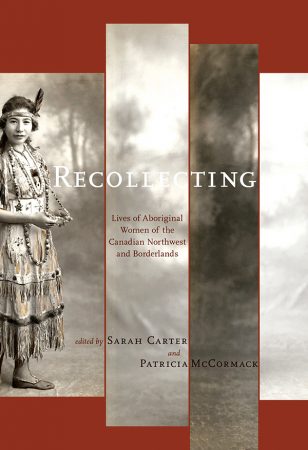
Recollecting Lives of Aboriginal Women of the Canadian Northwest and Borderlands
edited by Sarah Carter and Patricia A. McCormack
A co-publication with the University of Alberta Press
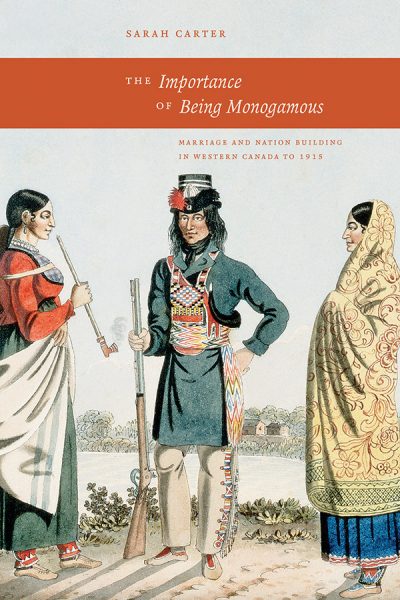
In The Importance of Being Monogamous, Sarah Carter reveals how marriage became a cornerstone of colonial control and social engineering in Western Canada in the late nineteenth century. Carter exposes how Christian, monogamous marriage was imposed as a civilizing mission that would regulate gender, race, and sexuality in the name of progress. Lucidly written and richly researched, this book revises what we know about marriage and the gendered politics of late nineteenth century reform, shifts our understanding of Indigenous history during that time, and brings together the fields of Indigenous and migrant history in new and important ways.
The Importance of Being Monogamous provides a fascinating account of how, especially between 1870 and 1915, when patriotic British imperial fervour saw the dominant entrenchment of the new order, the complex social order based on aboriginal and Métis models was finally eclipsed… Sarah Carter’s book forms an important chapter in the story of Western Canada’s transformation.
Ken Tingley, Edmonton Journal
This sophisticated and engaging book has much to offer a number of scholarly areas, including Canadian history, gender studies, and political and legal studies. Working from a massive bedrock of diverse primary materials, Sarah Carter challenges assumptions about the institution of marriage, revealing its complexities and importance in the colonial past… It is an important study that opens up multiple areas for further research; in particular, exploration of the limits of the law to control the intimate histories of people going about their everyday lives.
Katie Pickles, BC Studies
This is too important a book to be confined to the libraries of scholars, even though they may be the principal targets of a university publisher….The Importance of Being Monogamous is a worthy example of history amplified and enriched.
Ron Kirbyson, The Winnipeg Free Press
This vast book is a thorough social and legal exploration into the settlement of Western Canada and the contested role that marriage played in establishing the nation.
J. B. Edwards, Choice
Through her intimate knowledge and incredibly well-researched account of the West in the late nineteenth century, [Carter] provides the reader with many compelling stories of experiences endured by Aboriginals, and the British colonists’ often incredulous responses. The enlightening anecdotes and cogent discussion make this book appealing to a broad audience.
Adrienne Roy, Saskatchewan Law Review
Carter assembles a vast archive of policy directives, correspondence, legal decisions, journalism, census data, exploration and travel literature, missionary and police reports, and early social science to provide this fascinating account of the tensions and uncertainties, the unpredictable contradictions and loopholes, created by the effort to unravel ancient systems of social organization through the imposition of a different moral code.
Jennifer Henderson, American Historical Review
Carter has written an important book that will challenge scholars of other colonial regions, particularly the U.S. West, to pursue similar questions. It is a compelling text that deserves wide attention.
Margaret D. Jacobs, Pacific Historical Review
Carter admirably wades through the complex and tangled webs of policy and legal precedents surrounding indigenous marriage laws and state policy. She clearly explains the insidious ways the state tried to control indigenous people and the means by which indigenous people resisted domestic invasion. She provides insightful comparisons to other colonial situations and consistently places her findings in a variety of historiographical contexts.
Carolyn Podruchny, The Western Historical Quarterly
The Importance of Being Monogamous is of crucial importance to all legal academics, practitioners and students interested in exploring critically law’s understanding of and approach to ‘unorthodox’ marriages.
Angela Campbell, Ottawa Law Review
This is not your grandmother’s Western Canadian history…. The book is full of such untold stories, making it a must-read beyond the confines of ‘regional’ Canadian history.
Karen Dubinsky, University of Toronto Quarterly
In this brilliantly titled book Sarah Carter again demonstrates her pre-eminence in the field of Western Canadian history, especially in the area of Native-newcomer relations…. Carter’s book is essential, not just for those interested in gender, race, and colonization but for those who wish to have any hope of understanding Western Canadian or Canadian history.
Myra Rutherdale, Labour/Le Travail
What makes Carter’s work particularly compelling is her painstaking use of Canadian government documents, Hudson’s Bay Company employee accounts, and divorce court proceedings that expose the Department of Indian Affairs’ obsession with replacing that historical form of union with a ‘new’ family code.
Katherine Ann Roberts, American Review of Canadian Studies
“A timely study of Canada’s efforts at the turn of the twentieth century to impose monogamy on its western frontier in communities long used to fur trade marriage by the custom of the country…..Carter’s new book offers a rich, well-documented historical context for those involved in such challenging areas of public policy.”
Jean Friesen, Great Plains Quarterly
This work is licensed under a Creative Commons License (CC BY-NC-ND 2.5 CA). It may be reproduced for non-commercial purposes, provided that the original author is credited.
edited by Sarah Carter and Patricia A. McCormack
edited by Gerald T. Conaty
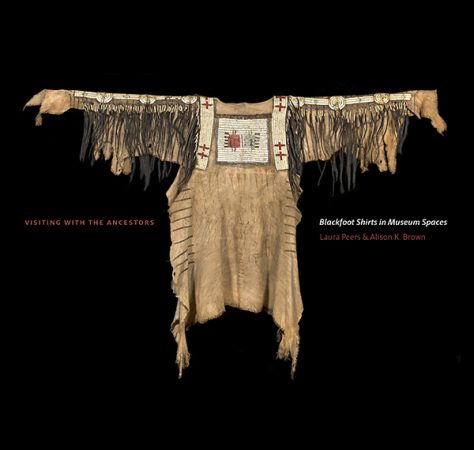
Laura Peers and Alison K. Brown