![[book cover] Bomb Canada and Other Unkind Remarks in the American Media](https://www.aupress.ca/app/uploads/120159_Bomb-Canada-and-Other-Unkind-Remarks-in-the-American-Media-cover-291x450.jpg)
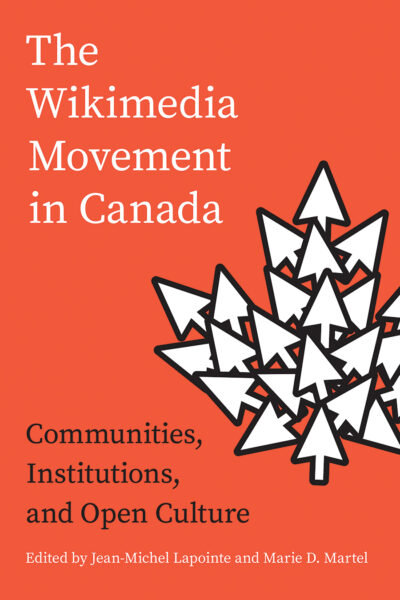
The Wikimedia Movement in Canada examines the distinctive role Canadians have played in creating and sustaining the world’s largest free encyclopedia. Drawing on interdisciplinary case studies, this volume investigates how Wikimedia projects transform the creation, circulation, and governance of knowledge. Contributors probe the relationship between identity and contribution across English, French, and Atikamekw Wikipedias, attending to questions of diversity, representation, and inclusivity. They analyze institutional partnerships, demonstrating how collaborations extend public access to cultural knowledge and reshape institutional practices. Finally, they explore the forms of literacy required for meaningful engagement in Wikimedia environments, including digital, legal, and algorithmic literacies, and reflect on their implications for both amateur and professional contributors. A rich, multifaceted examination of open culture in practice, this volume offers a rigorous exploration of how collaboration and knowledge-sharing shape Canada’s evolving digital landscape.
Table of Contents
- Introduction
- Focus I. Identities
- 1. Protocols of Pluralization: Negotiating Cultural Cohabitation in Wikipedia
Nathalie Casemajor - 2. Does Wikipedia’s Acadia Portal Offer an Accurate Portrait?
Gabriel Arsenault and Mathieu Wade - 3. Using Wikidata to Quantify the Gender Gap in Biographical Resources
Marie D. Martel and Simon Villeneuve
- 1. Protocols of Pluralization: Negotiating Cultural Cohabitation in Wikipedia
- Focus II. Institutions
- 4. Wikidata in Canada and the Mariposa Folk Festival Linked Data Project
Stacy Allison-Cassin - 5. Wikimedia in a Québec Art Museum: Exploring an Open Cultural Institution Model
Nathalie Thibault - 6. Open Government: A Wiki to Link Them All Together
Miguel Tremblay
- 4. Wikidata in Canada and the Mariposa Folk Festival Linked Data Project
- Focus III. Literacies
- 7. Public Knowledge During the COVID-19 Infodemic: Health Literacy and the Effect of Wikipedia
Denise Smith
- 7. Public Knowledge During the COVID-19 Infodemic: Health Literacy and the Effect of Wikipedia
- Afterword: The Value of Verified Knowledge in the Age of Generative AI
Pierre Lévy - List of Contributors
This work is licensed under a Creative Commons License (CC BY-NC-ND 4.0). It may be reproduced for non-commercial purposes, provided that the original author is credited.
You may also like...
![[book cover] Class, Community and the Labour Movement](https://www.aupress.ca/app/uploads/2019/11/Class-Community-and-the-Labour-Movement-306x450.jpg)
Class, Community and the Labour Movement Wales and Canada, 1850-1930
edited by Deian R. Hopkin and Gregory S. Kealey, with an introduction by David Montgomery
Speaking Power to Truth Digital Discourse and the Public Intellectual
edited by Michael Keren and Richard Hawkins
The Digital Nexus Identity, Agency, and Political Engagement
edited by Raphael Foshay