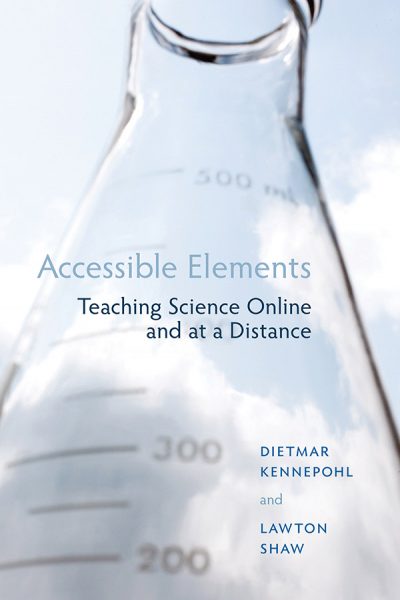
Accessible Elements:
Teaching Science Online and at a Distance
edited by Dietmar Kennepohl and Lawton Shaw
January 2010
Paperback
978-1-897425-47-3 (SC)
January 2010
eBook
978-1-897425-48-0 (ebook)
Series
Issues in Distance Education
Subject
Distance Education
About the Book
Accessible Elements informs science educators about current practices in online and distance education: distance-delivered methods for laboratory coursework, the requisite administrative and institutional aspects of online and distance teaching, and the relevant educational theory.
Delivery of university-level courses through online and distance education is a method of providing equal access to students seeking post-secondary education. Distance delivery offers practical alternatives to traditional on-campus education for students limited by barriers such as classroom scheduling, physical location, finances, or job and family commitments. The growing recognition and acceptance of distance education, coupled with the rapidly increasing demand for accessibility and flexible delivery of courses, has made distance education a viable and popular option for many people to meet their science educational goals.
About the Editors
Dietmar Kennepohl, FCIC, is Associate Vice President Academic and Professor of Chemistry at Athabasca University.
Lawton Shaw is Assistant Professor of Chemistry at Athabasca University.
Advanced Praise
“Kennepohl and Shaw are to be congratulated on bringing together accounts of new approaches to how we teach science at a distance. The possibilities that ICT provide have revolutionised the field, and this volume brings us up to date with what can be done.”
Alan Tait
Professor of Distance Education and Development,
and Pro Vice Chancellor (Curriculum and Awards), The Open University, UK
President, European Distance and E-Learning Network (EDEN)
“Accessible Elements is excellent reading for those serious about science education. The authors share perspectives on the challenges of educating at a distance for all the sciences, including the often neglected Earth Sciences.”
Godfrey Nowlan
Geological Survey of Canada
President, Canadian Geoscience Education Network
“From the work and experience of many people across the globe, Accessible Elements has built a remarkably coherent guidebook to distance education in the computer age. It is both eminently practical and visionary.”
Roald Hoffmann
Nobel Laureate in Chemistry, educator, and writer
Download the eBook
Copyright: This work is licensed under a Creative Commons License. It may be reproduced for non-commercial purposes, provided that the original author is credited.
Select a Chapter
DownloadFront Matter
DownloadTable of Contents
DownloadForeword
DownloadIntroduction
Learning
DownloadChapter 1
Interactions Affording Distance Science Education
Terry Anderson
DownloadChapter 2
Learning Science at a Distance: Instructional Dialogues and Resources
Paul Gorsky and Avner Caspi
DownloadChapter 3
Leadership Strategies for Coordinating Distance Education Instructional Development Teams
Gale Parchoma
DownloadChapter 4
Toward New Models of Flexible Education to Enhance Quality in Australian Higher Education
Stuart Palmer, Dale Holt, and Alan Farley
Laboratories
DownloadChapter 5
Taking the Chemistry Experience Home — Home Experiments or "Kitchen Chemistry"
Robert Lyall and Antonio (Tony) F. Patti
DownloadChapter 6
Acquisition of Laboratory Skills by On-Campus and Distance Education Students
Jenny Mosse and Wendy Wright
DownloadChapter 7
Low-Cost Physics Home Laboratory
Farook Al-Shamali and Martin Connors
DownloadChapter 8
Laboratories in the Earth Sciences
Edward Cloutis
DownloadChapter 9
Remote Control Teaching Laboratories and Practicals
Dietmar Kennepohl
Logistics
DownloadChapter 10
Needs, Costs, and Accessibility of de Science Lab Programs
Lawton Shaw and Robert Carmichael
DownloadChapter 11
Challenges and Opportunities for Teaching Laboratory Sciences at a Distance in a Developing Country
Md. Tofazzal Islam
DownloadChapter 12
Distance and Flexible Learning at University of the South Pacific
Anjeela Jokhan and Bibhya N. Sharma
DownloadChapter 13
Institutional Considerations: A Vision for Distance Education
Erwin Boschmann
DownloadAuthor Biographies
DownloadIndex
DownloadAbout the Editors