The Theory and Practice of Online Learning
edited by Terry Anderson
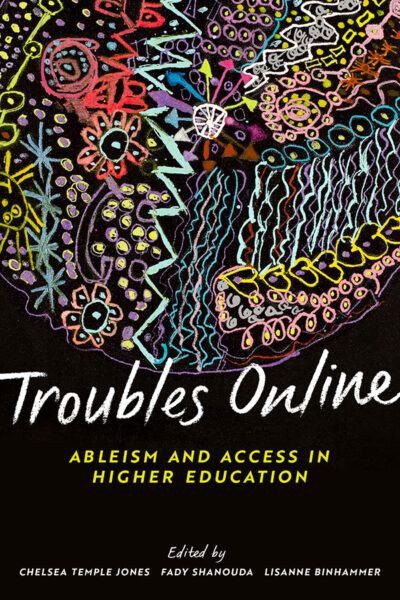
Online education is often heralded as a solution for accessibility to higher education; however, ableism thrives online. In this timely collection, contributors aim to trouble what online teaching looks like and think critically about how disability is addressed in online classrooms. Through narratives, poetry, interviews, and scholarly analysis, they reflect on disabled, mad, sick, and crip online pedagogy and highlight the possibilities of expanding critical standards for accessible teaching and learning. Necessarily interdisciplinary, this collection retheorizes the classroom around a justice-based approach to online pedagogy and challenges the assumptions we have around universal design. Refusing to position access as an afterthought, this collection troubles our engagement with online accessibility in uncertain and evolving times.
This volume has done a commendable job of raising awareness of multiple troubles that continue to plague the online learning pedagogical landscape.
Nigel Gearing, Journal of Open, Flexible and Distance Learning
The belief that online learning is accessible to all is a fallacy that needs further attention, resources, and dedicated review in higher education. This book is an excellent resource to begin these critical conversations as it unveils many experiences of missed opportunities for accessibility in online education, a topic that requires continued advocacy and greater consideration in higher education.
Kristina Burns, Brock Education Journal
Troubles Online effectively presents a new paradigm for the examination and praxis in critical digital pedagogy. It will be especially useful to educators who are seeking to develop their own critical digital praxis, as well as researchers looking for a launch point in this area.
Catie Sahadath, Canadian Journal of Education
This work is licensed under a Creative Commons License (CC BY-NC-ND 4.0). It may be reproduced for non-commercial purposes, provided that the original author is credited.
edited by Terry Anderson
edited by Mohamed Ally
Dianne Conrad and Jason Openo

Kristin Petrovic, Lynn Corcoran, Emily Doyle, and Terra Murray