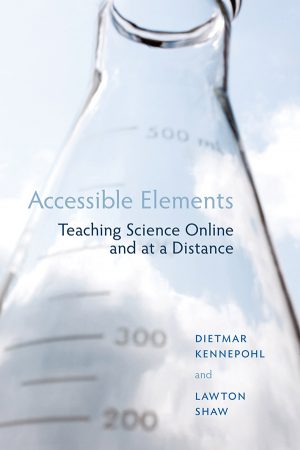
Accessible Elements Teaching Science Online and at a Distance
edited by Dietmar Kennepohl and Lawton Shaw
The global demand for higher education is greater than what can be met by conventional education routes at campus-based institutions. The unique requirements around laboratory and practical educational components in science education pose a particular problem for meeting this demand. Evolving beyond the walls of the traditional brick-and-mortar institution and long-established modes of teaching and learning will be essential for training the next generation of scientists and technical professionals and ensuring scientific literacy in modern society.
This new volume from the editors of Accessible Elements:Teaching Science Online and at a Distance, presents innovations for open, online, and distance-delivered programs that can help meet the global demands for higher education in science and technology. Contributors reassess what science teaching labs can and should be and explore innovations such as citizen science, virtual field experiences, and the use of smartphone technology to replace lab instrumentation. Other areas of focus include pedagogical and course design innovations, such as the use of open educational resources and the use of learning analytics and AI to drive adaptive learning. Programmatic innovations, such as work-integrated learning and micro-credentials that can help make higher education more accessible to lifelong learners, are another area of emphasis. This book is for science educators, higher education administrators, and anyone who is interested in the future of online and distance delivered higher education in science.
This work is licensed under a Creative Commons License (CC BY-NC-ND 4.0). It may be reproduced for non-commercial purposes, provided that the original author is credited.
edited by Dietmar Kennepohl and Lawton Shaw

Charles Noble
Michael Power
edited by Elizabeth Burge, Chère Campbell Gibson, and Terry Gibson